
Use of Pollen Morphology Traits for Identifying Species of Centaurea L. Asteraceae in Kurdistan-Iraq
Article Sidebar
Main Article Content
Abstract
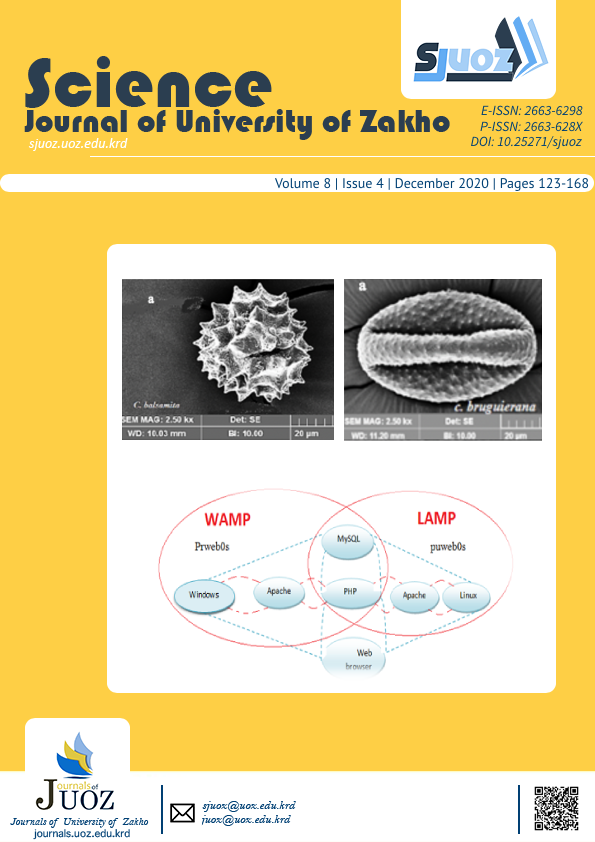
The polleniferous material of Centaurea taxa grow in Kurdistan-Iraq was collected. Samples were tested using scanning electron microscopy (SEM) and light microscopy (LM). In the polar view, pollen grain outlines are mostly triangular or triangular-circular. In equatorial view, the elliptic shape is common, while circulars or semicircular shapes are rare. The exine sculpture is scabrate, and the tectum is perforate. Number of sculpture microspinules/ µm², and their heights together with the number of wall perforations provide significant characters for taxa delimitation. Pollen grains of all species are of medium size, very few of some species pollen are larger or smaller in size. Species producing subprolate pollen shape is common, while oblate spheroidal and Prolate spheroidal shapes are less common. The principal component analysis and the discriminant analysis can recognize 65.478% and 87.54% of the total variability respectively; moreover, the discriminant function can correctly classify 125 or 78.125% out of 160 observations for pollen traits.
Downloads
Article Details
Section

This work is licensed under a Creative Commons Attribution 4.0 International License.
Authors who publish with this journal agree to the following terms:
- Authors retain copyright and grant the journal right of first publication with the work simultaneously licensed under a Creative Commons Attribution License [CC BY-NC-SA 4.0] that allows others to share the work with an acknowledgment of the work's authorship and initial publication in this journal.
- Authors are able to enter into separate, additional contractual arrangements for the non-exclusive distribution of the journal's published version of the work, with an acknowledgment of its initial publication in this journal.
- Authors are permitted and encouraged to post their work online.